
The moment your brain hijacks your body
You're with your partner. Things are moving in a good direction. But somewhere in your head, a voice starts narrating. Is this taking too long? Am I wet enough? Do they think I'm into this? Do I look okay right now? And just like that, sensation evaporates. Your body is still there, but your mind has left the building.
Performance anxiety during sex is one of the most common reasons pleasure gets blocked. It's not about wanting your partner less or being less attracted to them. It's about your nervous system getting stuck in your head instead of in your body.
Here's what I know after years of working with couples: the moment you stop focusing on "performing" and start focusing on sensation, everything changes. Lemon vibrators are quietly one of the best tools for getting you back into that sensory space, because they demand your attention in a way that's almost impossible to ignore.
Why performance anxiety kills arousal
Your brain can't actually multitask when it comes to pleasure. It's not designed to. When you're monitoring your performance, judging your body, or imagining what your partner is thinking, the same neural systems that create arousal are essentially offline. You're running two programs at once, and one of them is draining all the CPU power.
Performance anxiety typically shows up in a few patterns. Sometimes it's rooted in past feedback. "You're taking too long." "I don't think you're enjoying this." "Can you be quieter?" Sometimes it's just internalized cultural noise about what good sex is supposed to look like. Sometimes it's a new relationship where you're still proving yourself. Regardless of the source, the effect is the same: your body goes numb because your mind won't shut up.
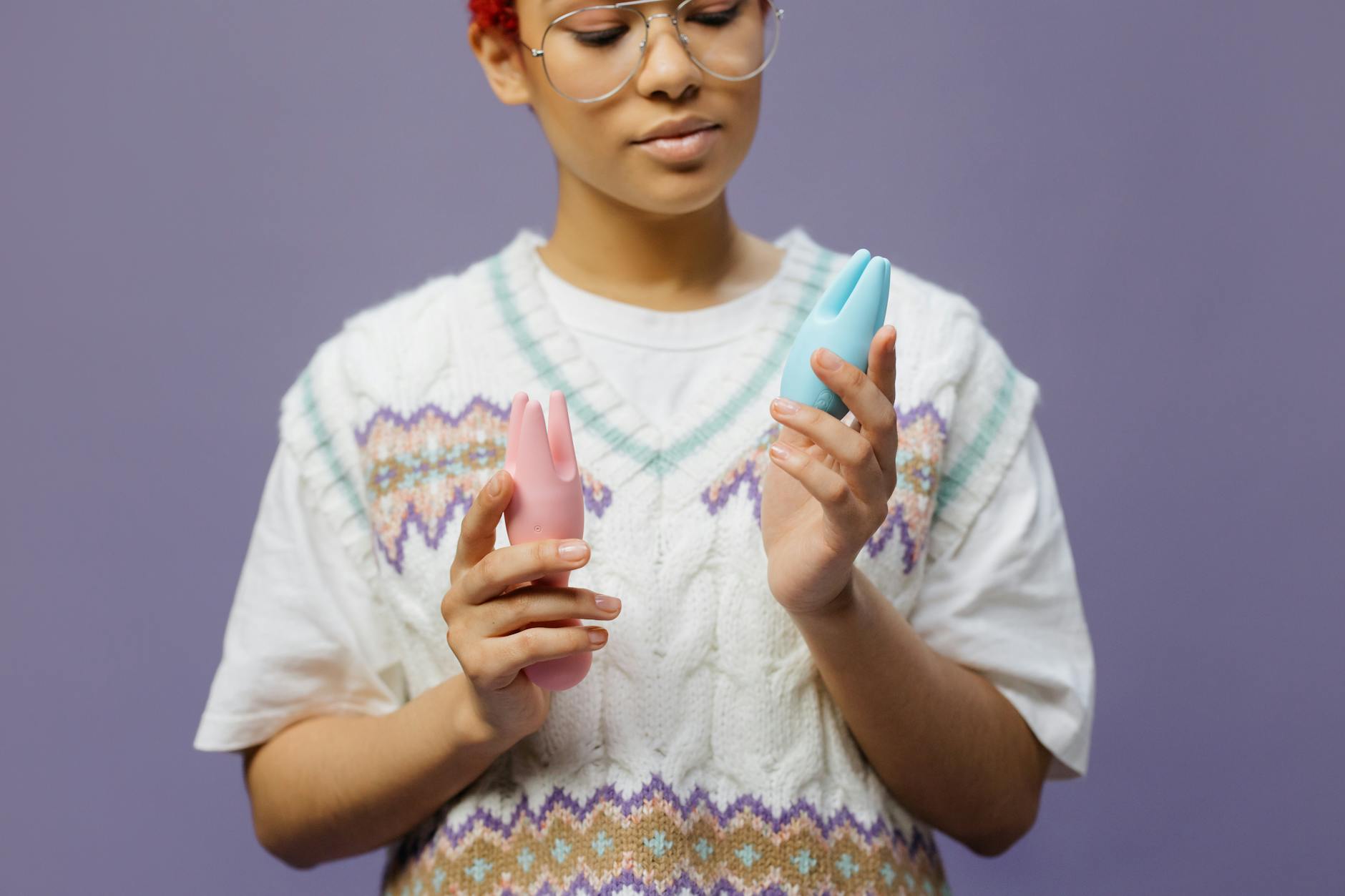
Photo by cottonbro studio on Pexels
How sensation redirects your attention back to your body
This is the part most people don't understand about vibrators in the context of performance anxiety. They're not just another toy. They're a circuit breaker for the anxious thought loop.
When you're using a lemon clitoral vibrator, the sensation is strong enough, consistent enough, and unique enough that your brain has to pay attention to it. You can't fake it or zone out. The vibration demands presence. That's not a side effect. That's the whole mechanism.
Think of it like this: if you're in a conversation where someone is judging you, you can kind of half-listen while anxiety narrates in the background. But if someone suddenly taps your shoulder or hands you something unexpected, you snap to attention. That's what a lemon vibrator does to your nervous system. It interrupts the anxiety loop by introducing sensation that's impossible to ignore.
The best part is that this actually makes you more present with your partner, not less. When you're grounded in your own body and your own pleasure, you're not performing. You're actually there.
The shift from monitoring to feeling
I often tell clients that using a vibrator with a partner during sex is an act of communication. You're literally showing them what works, what feels good, and what keeps you in your body. That's more honest than performing ever could be.
Here's what typically happens when someone starts using lemon vibrators with this specific intention. First session with your partner present, you might still feel self-conscious. That's normal. The second or third time, you start to notice that you're actually in your body. Your partner is likely more turned on watching you feel good than they ever were watching you perform. That alone can flip the entire dynamic.
The key is framing it right from the start. Not "I need this because I'm broken." Not "Sorry, I'm taking too long." Just "I want to try this. It helps me feel more." Full stop. Your pleasure is not a problem that needs apologizing for.
Practical setup for using lemon vibrators without added pressure
Timing matters. If you introduce a vibrator when the anxiety is already in full swing, it might feel like one more thing to worry about. Instead, bring it in early, when you're both relaxed and curious.
Start external only. If you're already anxious, adding penetration just adds another variable. Let yourself explore clitoral stimulation alone. Most people find that once they're already aroused, adding a vibrator is the thing that tips them over. You're not starting from anxiety. You're starting from partial arousal and letting the vibrator deepen it.
Use it solo first, honestly. Before you use a lemon vibrator with a partner, spend time with it alone. Not to become dependent on it, but to understand how it feels, what patterns work for you, and what rhythm gets you to orgasm. That knowledge is your foundation. Then when you're with your partner, you're not discovering it for the first time. You're just adding another person to something you already trust.
Communicating with your partner about why this helps
Partners who understand the "why" are much more likely to be enthusiastic. If you frame it as "I want to try this toy," they might worry you're not into them. If you frame it as "When I use this, I'm able to get out of my head and actually feel more," most partners get it immediately.
You could say something like: "I notice I sometimes get in my head during sex. When I do, I disconnect from sensation. Using a vibrator helps me stay present because the sensation is strong enough that I can't think about anything else. I want to try that with you."
That's honest. It's not blaming them. It's not making your pleasure their responsibility. And it actually draws them into the solution instead of making them feel like the problem.
When pleasure starts to return
One of the things I notice with clients is that once the performance anxiety breaks, it often breaks for good. Not immediately. But after a few experiences of actually feeling pleasure instead of monitoring it, the neural pathway shifts. Your brain starts to expect sensation, not judgment.
You might notice that you start orgasming faster. That you're wetter earlier. That your partner can read your body better because you're actually responding instead of pretending. All of that is your nervous system moving out of fight-or-flight and into rest-and-digest. Your body was always capable of this. It just needed permission to stop performing.
Some people find that after a few months of using lemon vibrators with their partner, they eventually don't need them every time. They've rewired their default setting back to sensation. Others find they prefer using them regularly because it consistently keeps them in their body. Either path is fine. The tool works because it works for you.
What to do if your partner resists
Occasionally, a partner feels threatened by the introduction of a toy. That's real, and it deserves a real conversation. It's not something you can vibrate away.
Typically, the fear is one of a few things: "You're saying I'm not enough." "You secretly want something else." "This means you don't actually want me." None of those are true, but the feelings are real.
The conversation might go: "I'm not bringing this in because of you. I'm bringing it in because of me. When I can focus on sensation instead of whether I'm doing this right, I'm actually more into you, not less. I want you to see me feel good. That turns me on." If he still resists after that, you have a different problem than performance anxiety. You have a partner communication issue that might benefit from couples therapy. That's okay to name.
But most partners, when they see their partner actually experiencing pleasure instead of performing it, come around quickly. They realize they'd rather have you present and turned on than perfect and somewhere else.
FAQ: Common questions about vibrators and performance pressure
Will using a vibrator make my partner think I don't enjoy sex with them?
Not if you frame it correctly from the start. The key is presenting it as something that helps you stay present, not something you need because they're failing you. Most partners find it hot to watch someone they care about actually feel good instead of pretending.
Do I have to use the vibrator every time, or can I use it just when I'm feeling anxious?
You get to decide. Some people use it every time they have sex because it helps them stay grounded. Others use it when they notice anxiety creeping in. Neither is wrong. Think of it like going to the gym. You don't have to do the same workout every time to get the benefits.
What if I can't orgasm even with the vibrator?
Then you're not dealing with just performance anxiety. You might be dealing with deeper trust issues, depression, medication side effects, or relationship dynamics that go beyond what a toy can fix. That's a conversation for a therapist, not a vibrator. But most people find that once the performance pressure is off, orgasm becomes easier, not harder.
Can I use a lemon vibrator if my partner and I aren't comfortable talking about sex directly yet?
Yes, but it's harder. You'd be introducing the tool without the conversation, which might create more anxiety, not less. A better approach: start the conversation small. "I've been feeling some pressure during sex and I want to try something different." You don't need to have a five-hour discussion. Just name what's real.
Will the vibrator become a crutch and make me dependent on it?
Possible, but unlikely if you're intentional about how you use it. The goal is to use it to interrupt the anxiety pattern until your nervous system resets. Once you've experienced real pleasure without the performance pressure, your body remembers that. You're not becoming dependent. You're retraining.
Should I use the vibrator during penetration or before?
Both work. Some people use it during foreplay to get fully aroused and out of their head before penetration. Others use it during, with their partner stimulating elsewhere. Some use it after. Experiment and see what keeps your nervous system in sensation mode. There's no single right way.
The real goal: getting you back in your body
Performance anxiety is a nervous system problem masquerading as a sex problem. Lemon vibrators help because they interrupt the anxiety loop and pull your brain back into sensation. They work because your body needs to feel something stronger than the noise in your head.
You don't need a vibrator because you're broken. You need it because your nervous system got hijacked by pressure, and sensation is the fastest way to get it back. Once you're back in your body, once you remember what pleasure actually feels like instead of what you think it should look like, everything changes.
If you're experiencing performance pressure and want to explore this further, we'd love to help you navigate it. Reach out anytime.
References
Gottman, J. M., & Gottman, J. S. (2017). The man's guide to women: Honest advice on attraction, love, and commitment. Rodale Books.
Barrón-Cedeño, J., & Litz, B. T. (2015). The relationship between anxiety disorders and sexual function: A systematic review. Journal of Sexual Medicine, 12(7), 1471-1480.
Meston, C. M., & Frohlich, P. F. (2000). The neurobiology of sexual function. Archives of General Psychiatry, 57(11), 1012-1030.